
 English


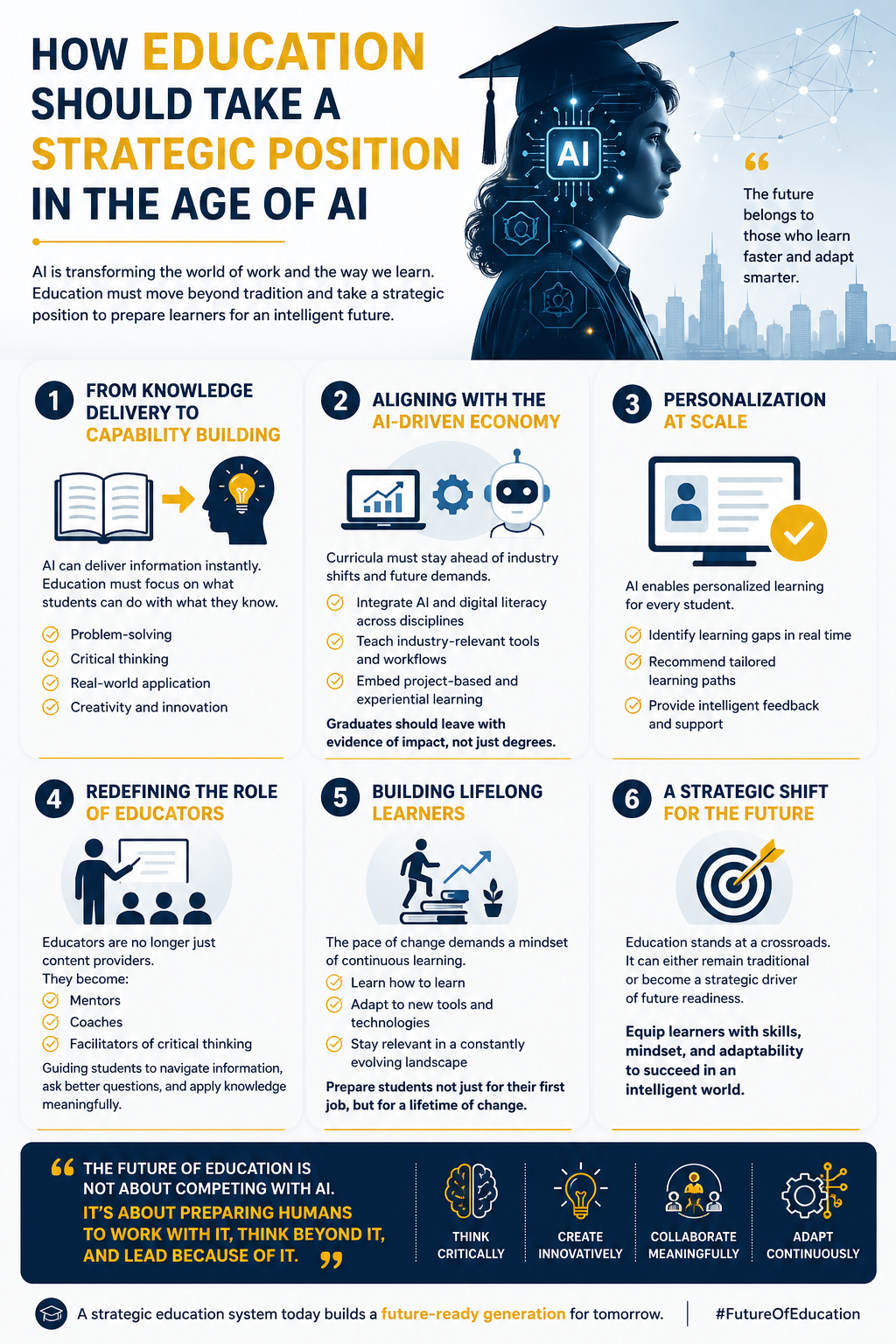
How Education Must Take a Strategic
Position in the Age of AI
Artificial Intelligence
is not just changing industries; it has now become the new normal. It's
redefining what it means to be educated, how education should be delivered, and
what educational content should include. In this new era, education can no longer
afford to be reactive. It must be strategic, adaptive, and deeply aligned with
the future of work. In a dissertation defended by Dr. Sylvanus Ngu-wara (2025),
he asserted that educational content, goals, and methods are deeply shaped by
technologies, including AI. This supports the claim that AI is inseparable from
education.
From Knowledge Delivery to Capability
Building
For decades, education focused on transferring
knowledge: lectures, textbooks, and exams. But AI can now generate, summarize,
and explain information instantly. This means the real value of education is
shifting from what students know to what they can do with it.
A strategic education system prioritizes:
-
Ready-to-work skills development
-
Problem-solving
-
Critical thinking
-
Real-world application
-
Creativity and innovation
In short, education must train practical skills, not
just theories or memory.
Aligning with the AI-Driven Economy
The job market is evolving faster than traditional
curricula can keep up with. Many roles are being redefined, and entirely new
ones are emerging. Education systems must proactively align with these shifts
by:
-
Integrating AI and digital literacy across
disciplines
-
Teaching industry-relevant tools and
workflows
-
Embedding project-based and experiential
learning
Graduates should leave not just with degrees, but with
evidence of impact, projects, portfolios, and practical experience.
Personalization at Scale
AI offers a powerful opportunity: personalized learning
on a scale. Instead of a one-size-fits-all model, education can adapt to each learner's
pace, strengths, and goals.
Strategic institutions will leverage AI to:
-
Identify learning gaps in real time
-
Recommend tailored learning paths
-
Provide intelligent feedback and support
-
This shifts education from standardized
delivery to individual growth journeys.
-
Redefining the Role of Educators
In the age of AI, educators are no longer just content
providers. They become:
-
Mentors
-
Coaches
-
Facilitators of critical thinking
Their role is to guide students in navigating
information, asking better questions, and applying knowledge meaningfully, areas
where human insight remains essential.
Building Lifelong Learners
The pace of change means education cannot end at
graduation. Strategic education systems must instill a mindset of continuous
learning.
This includes:
-
Learning how to learn
-
Adapting to new tools and technologies
-
Staying relevant in a constantly evolving
landscape
-
The goal is not just to prepare students
for their first job, but for a lifetime of change.
Conclusion
Education stands at a
crossroads. It can continue operating as it has for decades, or it can
reposition itself as a strategic driver of future readiness.
In the age of AI, the
institutions that thrive will be those that move beyond tradition and embrace
transformation, equipping learners not only with knowledge but also with the
skills, mindset, and adaptability to succeed in an intelligent world.
It is very important to
note that the future of education is not about competing with AI.
It's about preparing
people to work with it, think beyond it, and lead because of it.
