
 English


Introduction
Artificial Intelligence
(AI) is rapidly transforming how organizations use data. Over the past decade,
data professionals, including data analysts, data scientists, and data
engineers, have been essential to helping businesses extract insights from
large datasets. According to Forbes (2025), AI is not replacing these roles
today; instead, it is reshaping how they work, increasing productivity, and
expanding their strategic importance within organizations.
In the following
sections, we examine how AI is transforming data roles across industries,
uncover the new opportunities it is generating, and discuss the key skills
professionals should build to remain relevant.
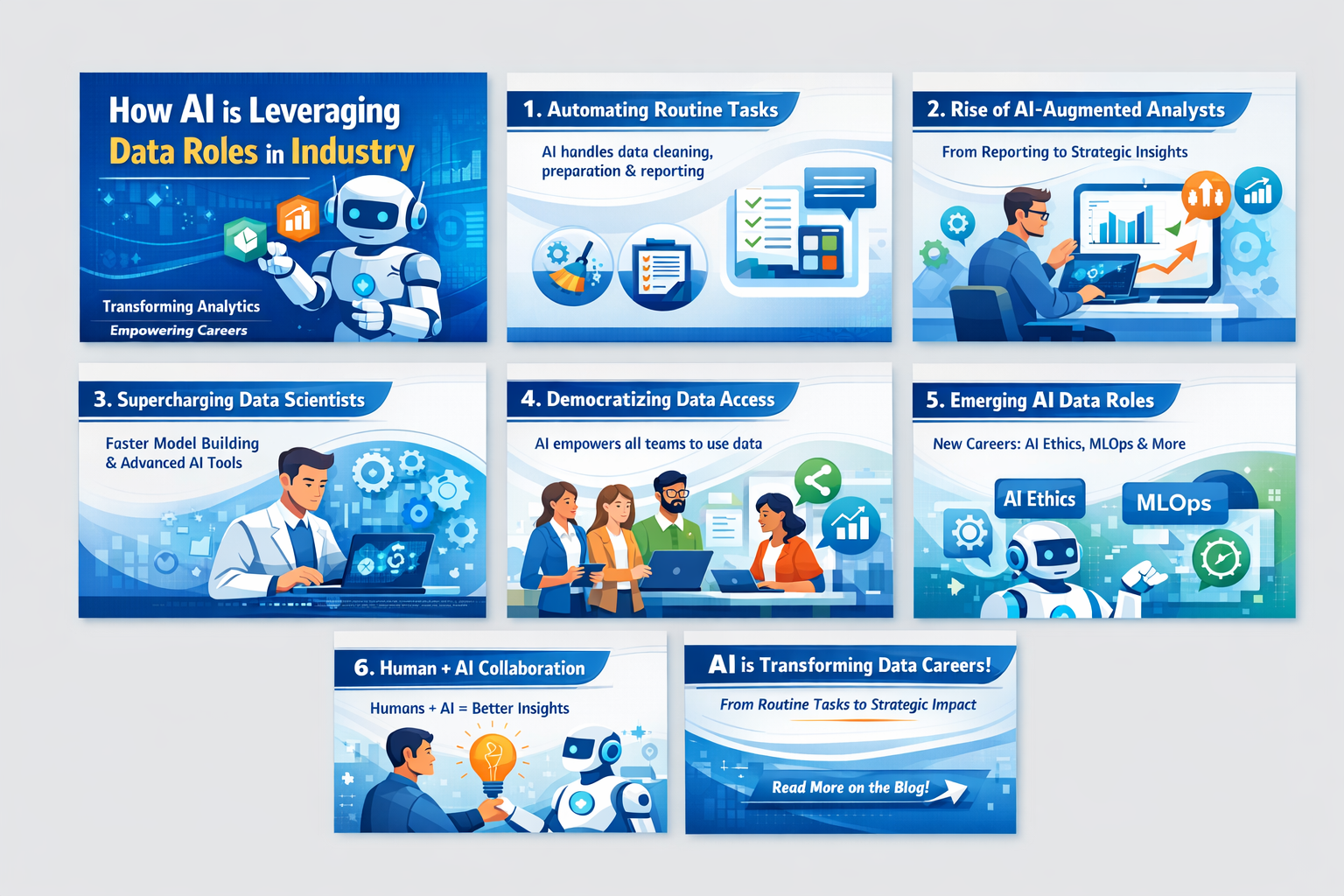
1.
Automation of Routine Data Tasks
One of the
most significant impacts of AI is the automation of repetitive tasks in data
workflows.
Previously,
data professionals spent large amounts of time on:
- Data cleaning
- Data preparation
- Basic reporting
- SQL queries and data
transformation
A 2025
Forbes report stated that AI-powered tools now automate many of these tasks.
For example, algorithms can detect anomalies, structure datasets, and generate
dashboards and visualizations.
Industry
Example
Employees
on marketing and operations teams can now generate reports directly using AI
tools without waiting for specialized analysts.
What
Impact on Data Roles?
Instead of
performing repetitive tasks, data professionals now focus on:
- Advanced analytics
- Business strategy
- Predictive modeling
- Data-driven decision support
2. The Rise of AI-Augmented Data Analysts
The role
of the data analyst is evolving from a technical report generator to a
strategic business advisor.
AI tools
allow analysts to:
- Ask questions in natural
language (NLQ)
- Automatically generate SQL
queries.
- Create instant visualizations
- Identify trends faster
However,
AI still relies on human expertise to interpret results and align them with
business strategy. Analysts remain essential because they provide the context,
judgment, and decision-making capabilities that AI lacks.
The New
Analyst Skillset
Modern
analysts increasingly focus on:
- Data storytelling
- Domain expertise
- AI-assisted analysis
- Strategic insight generation
3. AI
Supercharging Data Scientists
Data
scientists are experiencing augmentation rather than replacement.
AI now
accelerates several parts of the data science pipeline, including:
- Feature engineering
- Model training
- Hyperparameter tuning
- Code generation
This
allows data scientists to focus on high-value tasks, such as:
- Design experiments
- Developing advanced machine
learning models
- Interpreting AI outputs for
business decisions.
- Examples in Industry
In
manufacturing companies, AI systems monitor production metrics while data
scientists build predictive maintenance models that prevent equipment failures.
4. Democratization
of Data Across Organizations
AI is
making data analytics accessible to non-technical professionals.
Today,
employees in departments such as:
Sales
- Marketing
- Customer support
- Finance
- can use AI tools to analyze
data and generate insights.
This
phenomenon is called data democratization, in which analytics capabilities
extend beyond specialized teams.
- Benefits for Organizations
- Faster decision-making
- Data-driven culture
- Increased innovation
- Reduced analytics bottlenecks
Instead
of replacing analysts, AI expands the reach of data analytics across the entire
organization.
5.
Emergence of New Data Roles
As AI
adoption grows, new career paths are emerging in the data ecosystem.
Some
emerging roles include:
i. AI
Governance Specialists
Responsible for ensuring AI systems are ethical, fair, and compliant with
regulations.
ii. Data
Ethics Officers
Ensure responsible data use and protect user privacy.
iii. AI
Product Managers
Translate business needs into AI-driven products.
iv. AI
Operations Engineers (MLOps)
Maintain and monitor machine learning systems in production environments.
These
roles highlight the increasing intersection between data, AI, and governance in
modern enterprises.
6.
Human-AI Collaboration in Data Workflows
The future
of data work is not human vs. AI, it is human + AI collaboration.
AI
excels at:
- Pattern recognition
- Large-scale data processing
- Automation
Humans
excel at:
- Critical thinking
- Ethical reasoning
- Business understanding
- Creativity
- Together, they form a powerful
analytical partnership.
- Research increasingly
emphasizes this collaborative model, in which AI serves as an intelligent
assistant rather than a replacement.
7. Industry
Impact: AI in Action
Different
industries are already leveraging AI-powered data roles.
Healthcare
- AI predicts disease risks.
- Data scientists develop
diagnostic models
Finance
- Fraud detection systems
analyze millions of transactions.
- Analysts interpret anomalies
Retail
- AI analyzes customer behavior.
- Data teams optimize pricing
and recommendations.
Manufacturing
- Predictive maintenance
prevents equipment failure.
- Data engineers maintain
real-time data pipelines.
- Across sectors, organizations
are shifting toward AI-driven decision-making ecosystems.
8.
Challenges and Risks
Despite
the benefits, AI integration into data roles presents challenges:
Skill
Gaps
- Professionals must
continuously learn new AI tools and techniques.
Ethical
Concerns
- AI models can introduce bias
if trained on flawed datasets.
Over-Automation
Risks
- Blind reliance on automated
analytics can lead to incorrect conclusions.
- For this reason, human
oversight remains critical in data-driven organizations.
Conclusion
Artificial Intelligence does not eliminate
data careers; it is elevating them.
Instead of spending time on repetitive tasks, data
professionals now focus on:
- Strategic
analysis
- Business
innovation
- AI
model governance
- Decision-making
support
Organizations that
successfully integrate AI into their data workflows will gain a major
competitive advantage. Meanwhile, data professionals who embrace AI will find
themselves at the center of the next wave of digital transformation. In the AI
era, the most valuable professionals will not simply analyze data; they will
translate AI insights into business impact. Therefore, AI is transforming data
roles from technical execution to strategic intelligence leadership across
industries.
